


Brief Takeaways:
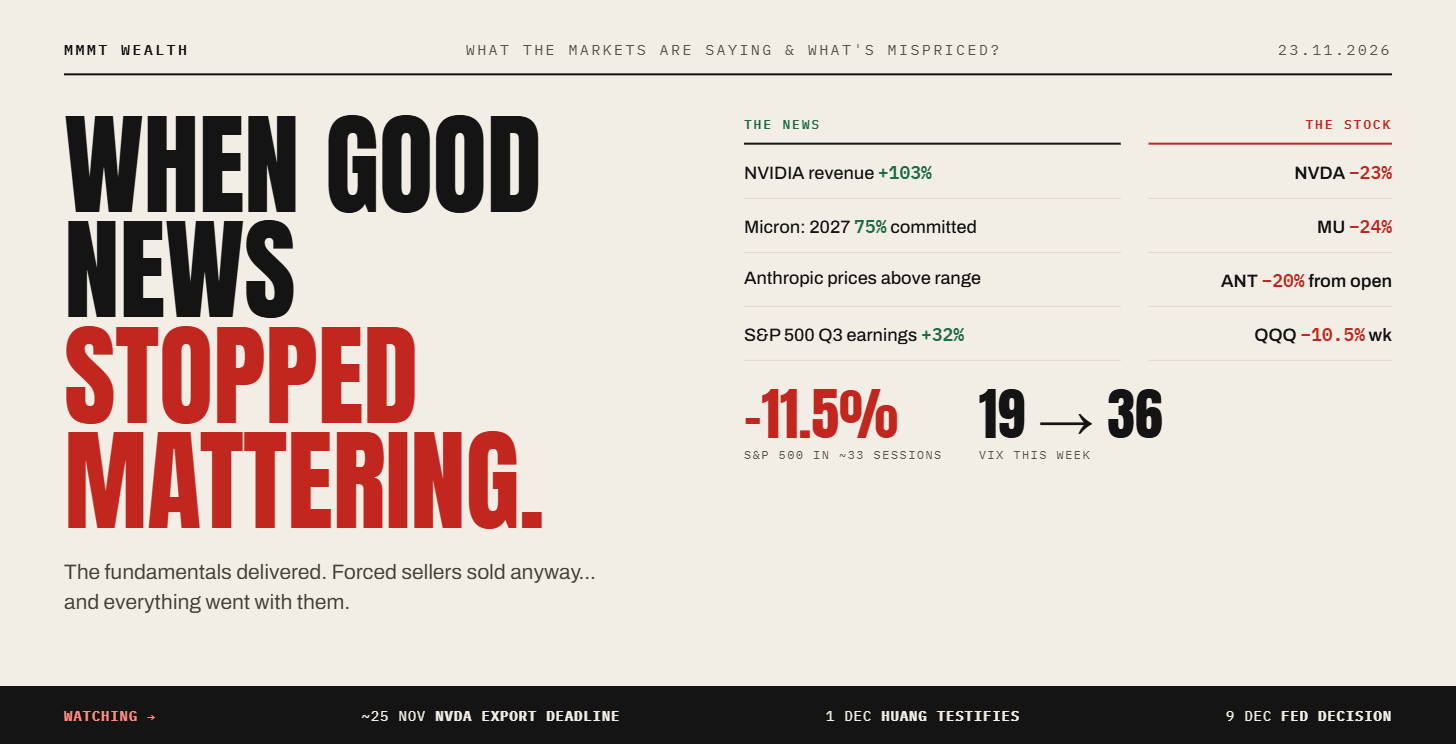
Good news stopped mattering last week. NVIDIA beat by $6.6B and raised guidance, Anthropic priced above its range in the largest IPO on record, and Micron said 2027 is already 75% committed. NVDA still fell 23% and the QQQ 10.5%.
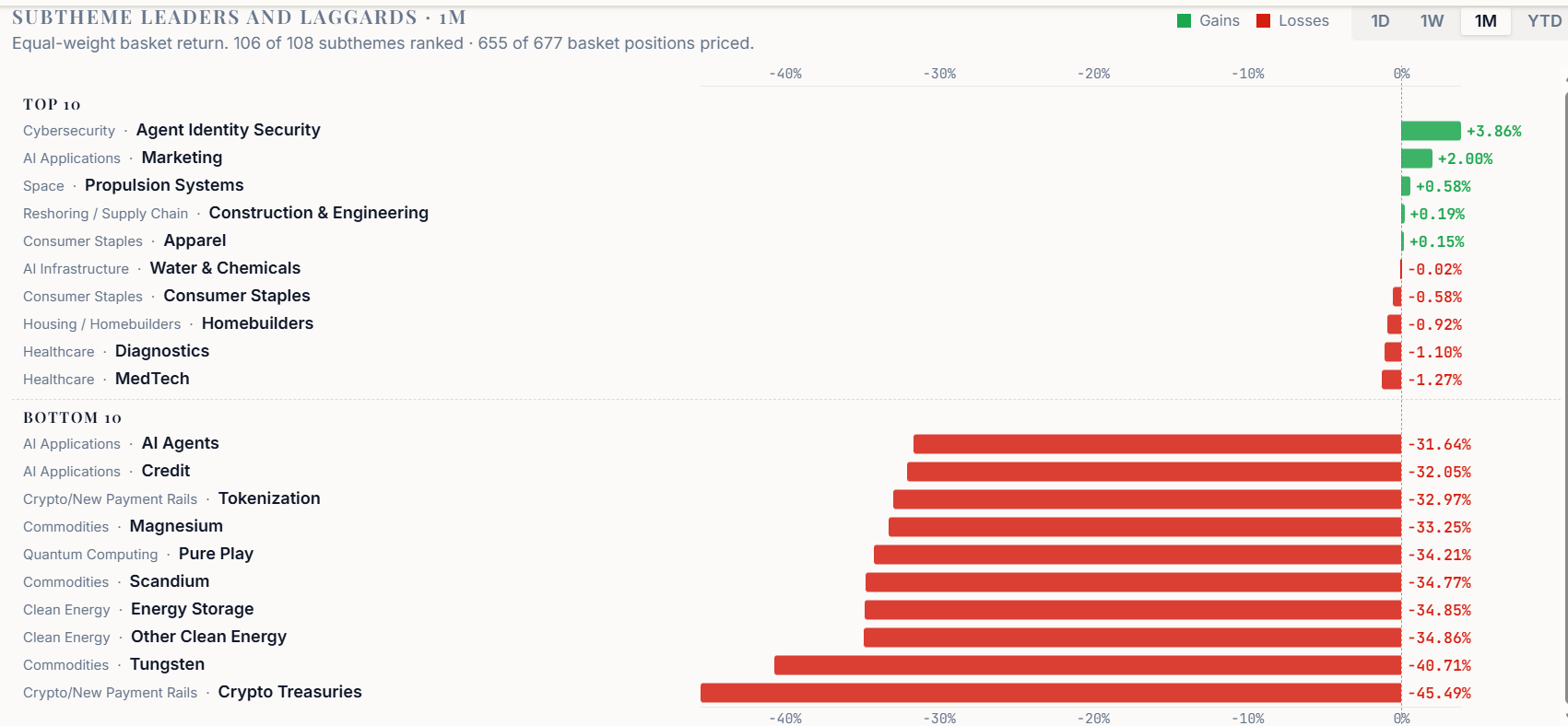
The selling spread to everything. Chips, gold, silver, copper, Bitcoin and Taiwan all fell hard together. When everything falls at once it’s a sign of forced selling rather than any fundamental on the micro level.
The damage is now in the indices. The QQQ is ~20% off its October peak, and the SPY, QQQ and IWM are all below their 200-day moving averages and have broken key support levels.
The bond market is already pricing lower inflation. Yields and inflation expectations both fell this week towards this random “2% goal”.
I’m more cautious than last week. I still haven’t been buying and this isn’t the time to catch a falling knife. I’m protecting capital, waiting for evidence that the forced selling is done, but remaining with a long-term bullish bias.
Good News Didn’t Matter
Last week I called this “the real test”. It turned out to be right…but not in the way we hoped as bulls.

I set out what a good week would look like for Anthropic: pricing at the top of the range and holding above the IPO price. Technically that happened:
Anthropic priced at ~$83 (above its $70-78 range) and raised $81.3B which is a great sign of the demand. It opened at $111.50 but then gave back almost all of it, touching $83.05 on Friday before closing at $88.91.
NVIDIA and Micron both delivered good news as well:
NVIDIA reported revenue of $115.8B (+103% year-on-year) beating estimates by $6.6B. They guided Q4 to ~$130B and added another $150B to its buyback.
Micron told investors on Wednesday that 2027 and 2028 will be even tighter than 2026 with 75%+ of 2027 output already committed.
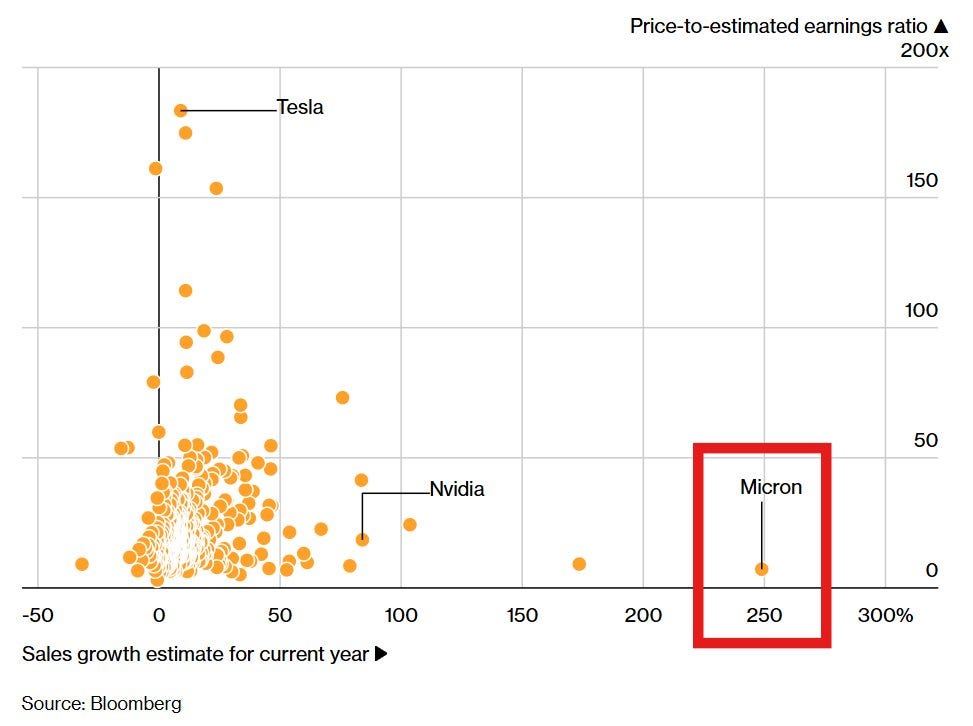
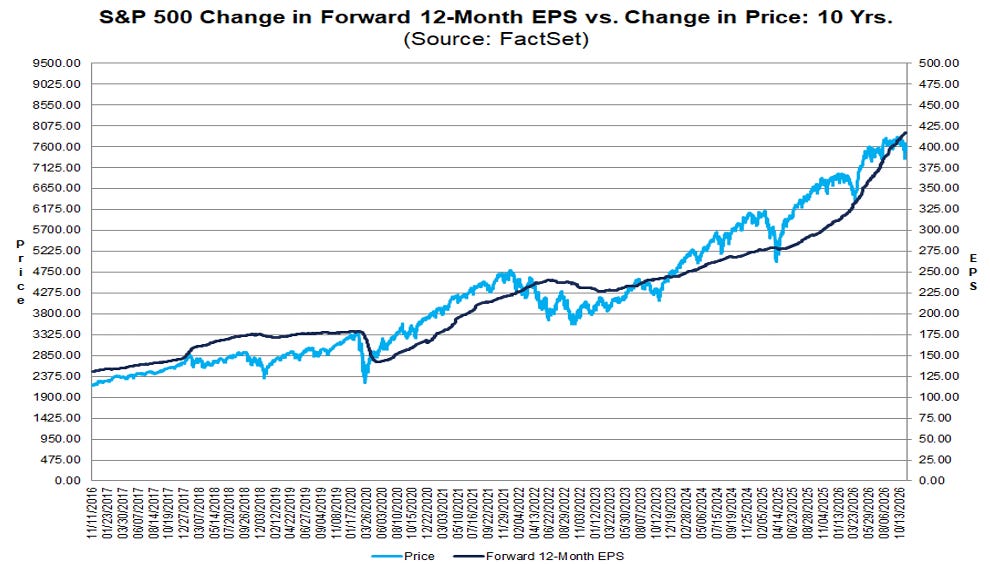
It's not just AI names either. S&P 500 earnings grew 31.9% in Q3 which is the third straight quarter above 25%…but the market continues to sell off (more on earnings in the below “The Indexes” section").
A few months ago this information would’ve been uber bullish for the markets…but instead we saw the above equities (NVDA, MU, ANT) fall ~20% this week alone.
The reason is simple - it’s a continuation of what we’ve seen happening for the last few weeks. When a fund takes big losses in its largest positions (and for most funds this year…that’s AI) its risk limits force it to cut exposure across the whole portfolio. It doesn’t get to choose what it sells based and instead sells whatever it can sell quickly and in size.
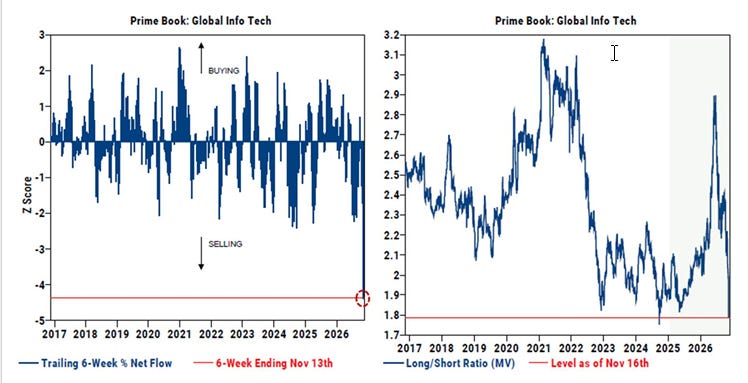
That’s why the selling hasn’t stayed in AI.
Gold, silver, Bitcoin and Taiwanese stocks were all popular, profitable trades this year which made them easy sources of cash. They fell not because anything changed in their own story but because the same funds owned them and needed to raise money.
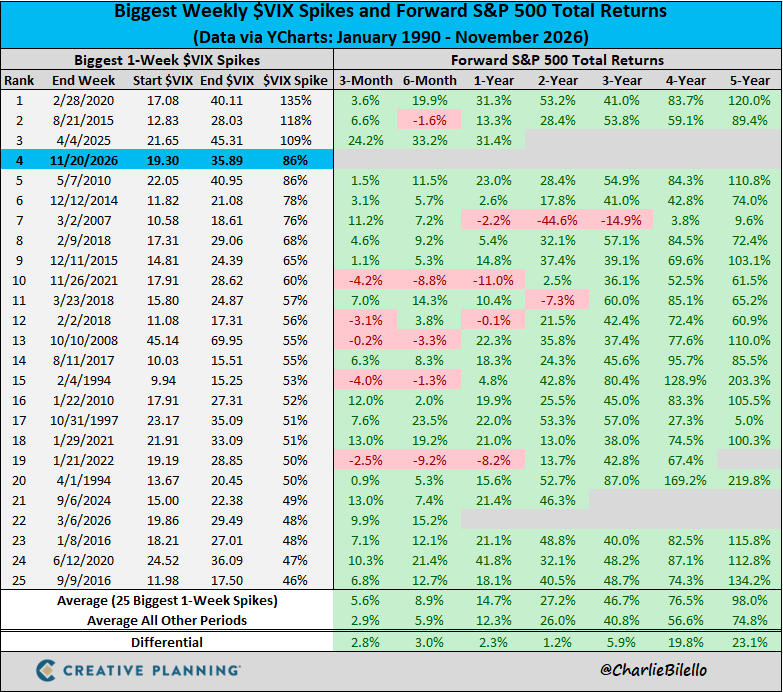
And when everything starts falling together, volatility jumps. The VIX went from 19 to 36 this week. Higher volatility makes every portfolio look riskier which forces even more cutting. The selling feeds itself until the funds that need to sell are done.
On a more positive note (forward looking)…look at the SPY returns post the 25 biggest VIX spikes since 1990 (more on this later).
None of this tells us the businesses are broken or the AI trade is over. What it does tell us is that someone still needs to sell... and until they’re done, the company news doesn’t really matter.
I remain more confident each week suggesting that we are in the late innings of the selloff.
NVIDIA
Last week I said the board wasn’t considering Jensen’s return. That’s still seemingly true but the story has escalated and is now acting as another drag on the market.
Treasury Secretary Bessent said NVIDIA needs a “dramatic shakeup” and should look outside the company for its next CEO. He gave the board and outside counsel 10 days (to around 25 November) to answer questions on export compliance.
Jensen has agreed to appear before three House committees on 1 December, with NVIDIA’s general counsel following on 2 December. He’s also said he’s ready to return if the board wants him back.
NVIDIA has set up a new board committee to oversee national security and export controls.
And it’s spreading. On Thursday, short seller Hunterbrook alleged that AMD’s hardware kept reaching a Chinese server maker blacklisted by the US. The claims are unverified and AMD denies them.
The result is that NVIDIA now trades on roughly 10x expected earnings over the next 12 months. That’s lower than most of the S&P 500 for a company that just grew 103%.
My view hasn’t changed unless something more material comes out of these investigations aside from just heresay. NVIDIA’s next 18-24 months are largely locked in by chips already designed and sold. But the governance overhang now runs into December at least and that’s a reason for big funds to stay away until it clears.
The Indexes & Earnings
The S&P 500 is down ~11.5% from its 6 October peak in around 33 trading days which makes it one of the fastest corrections on record.
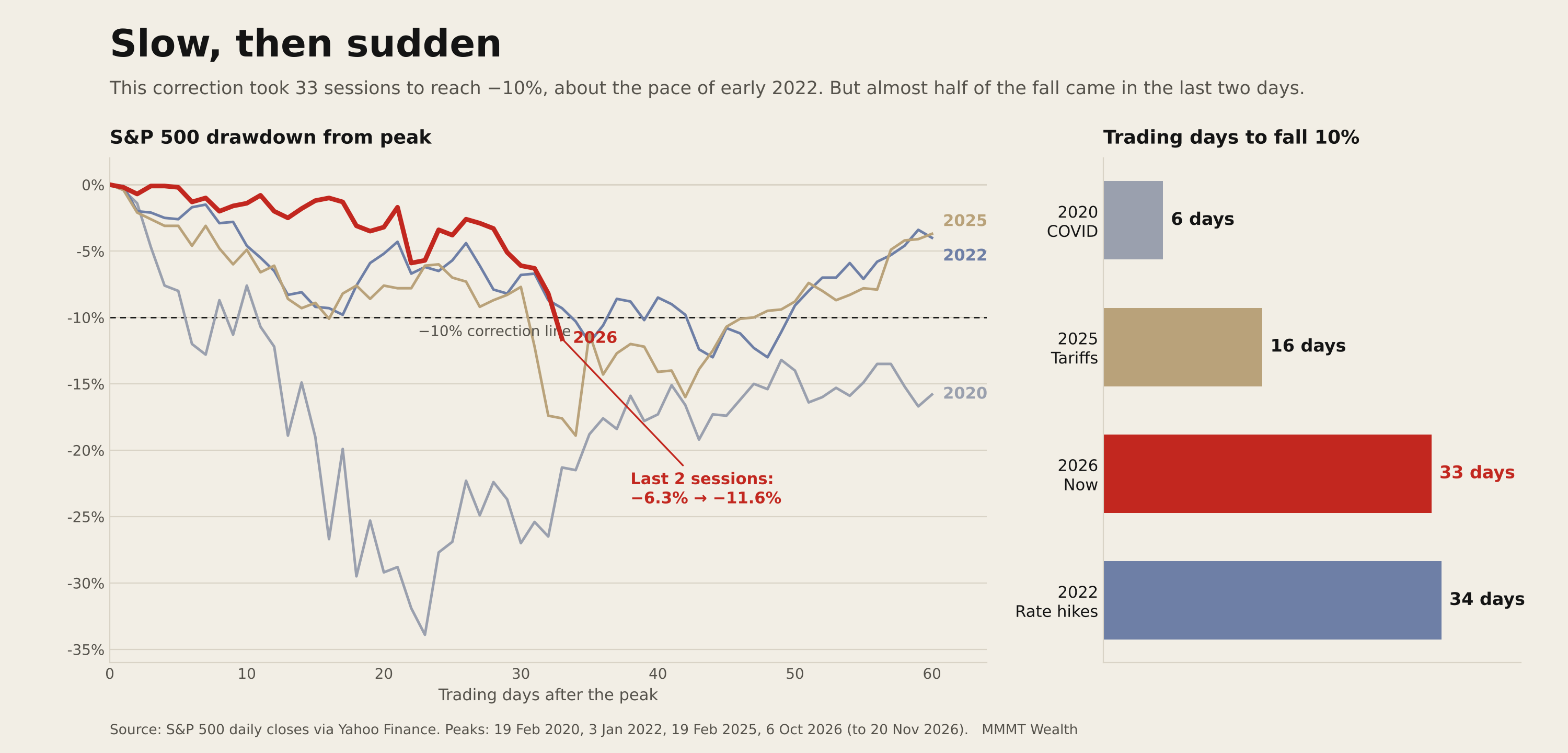
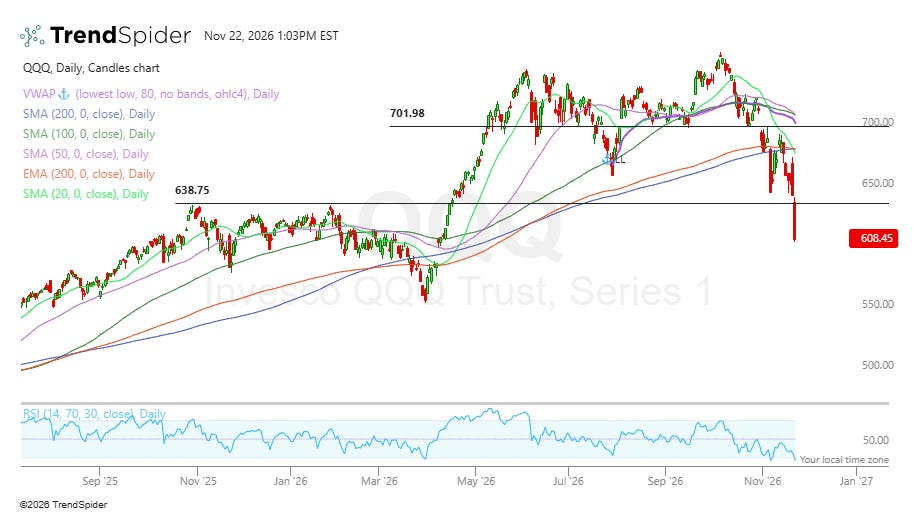
This last week alone the QQQ fell 10.5%…worse than any single week during the April 2025 tariff crash. We also broke the key 638 support level so structure has now turned incredibly bearish.
This is just more evidence that this is a positioning reset rather than a slowdown in the economy. Moves this fast in the market tend to be much more related to deleveraging…rather than a change in the economy/fundamentals.
Now we’ve broken this key 638 level the technicals begin to look a bit more complex as I’d like to see the index regain the support level and the 200D moving average.
On the downside potential…The QQQ is now ~11% below its 200-day moving average which is roughly 2.3 standard deviations below its average since 2010. The corrections of the last eight years (2018, 2020, 2025) typically bottomed 12-17% below the 200-day so I'm not assuming we're there yet.
Either way, consolidation is needed before I get interested in any material buying.
The Applications Layer
Application layer:
10.1% fall last week
17.7% fall since October 6th peak
Hardware layer:
20.1% fall last week
43.1% fall since October 6th peak
One shift I’m leaning into: the businesses using AI look steadier to me right now than the ones selling the hardware behind it.
1. Cheaper AI is a cost cut for them. The price war between OpenAI and Anthropic is bad news for model makers and the hardware behind them. OpenAI halved API prices for its latest models in September. But for any company using those models, the same intelligence now costs half as much. Usage keeps rising while spend has flattened which means the people buying AI are getting more for less. That margin mostly goes to the application layer.
2. They get paid on usage, not headcount. Companies that own data agents can’t work around (credit scores, ratings, indices, claims data), or that charge every time an agent does something, grow as agent activity grows. They don’t need to win the next hardware order cycle. They just need AI to keep being used.
3. No capital intensity. The hardware layer has to keep expanding capacity, and the cloud giants are now spending more than their entire operating cash flow on capex. Application companies get the benefit of better models without carrying that bill.
Compute is where the cycles live. Supply, pricing and financing all swing and this last week showed how quickly sentiment there can turn.
Memory is a good example. Micron says it’s sold out but TrendForce reported this week that spot memory prices are weak with the gap between spot and contract prices now over 20%.
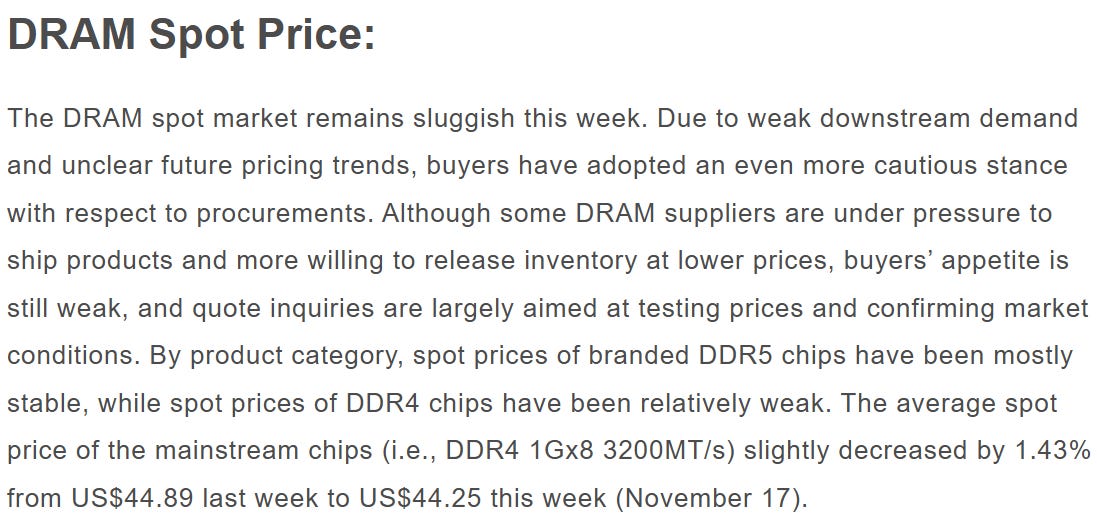
Mobile DRAM contract talks have stalled. Contract prices will keep rising but the gains will shrink each quarter. That doesn’t break the Micron (or memory) story but it just means memory is moving from “shortage” to “less of a shortage” and the stocks will price that before the earnings do.
Note: This is not a bearish take on the AI buildout. There’s still names there I’m very interested in.
Macro Update
The Fed is behind the market: It’s worth remembering where the Fed actually is.
It raised rates in September for the first time in over three years amid concerns over stubborn inflation driven recently by higher energy prices. In October it voted 10-2 to hold rates at 3.75% to 4% with two dissenters voting in favour of another 25bp hike.
The hawks haven’t backed down since. Just this week, Fed Governor Waller doubled down on his call for a half-point rate increase in December. Earlier this month, traders assigned more than an 80% probability to another hike in December.
That’s the key risk for the next few weeks. The Fed meets on 8-9 December. A hike into this backdrop, especially a 50bp one, would add more pressure to a market that’s already being forced to sell. A softer tone (or even a “one and done” signal) would be the most likely trigger for a proper turn.
Remember the comparison from earlier. The fast corrections in 2020 and 2025 recovered quickly. 2022 didn’t, because the Fed kept tightening. This is one of the key variables that may decide which way we head.
Valuations have reset: On November 5, the forward 12-month P/E ratio for the S&P 500 was 17.7 (below the 5-year average of 19.8 and the lowest since November 1, 2023). After this week it’s likely closer to ~16.7x.
Credit is still holding strong:
Investment grade spreads are steady at 0.94% whilst CCC spreads are at a 2026 high of 13.6%.
Lenders are pulling back from the weakest borrowers…not from the companies funding the bulk of the buildout.
What I’m watching (from a macro point of view) before getting more aggressive:
The Fed’s tone heading into 9 December.
The SPY, QQQ and IWM reclaiming their 200-day moving averages. They’re currently 5.9%, 10.9% and 8.2% below.
Investment grade credit staying calm.
I’d rather be late and right than early and wrong. There is no rush, or panic at the moment…despite what a lot of financial media may be suggesting.
Commodities
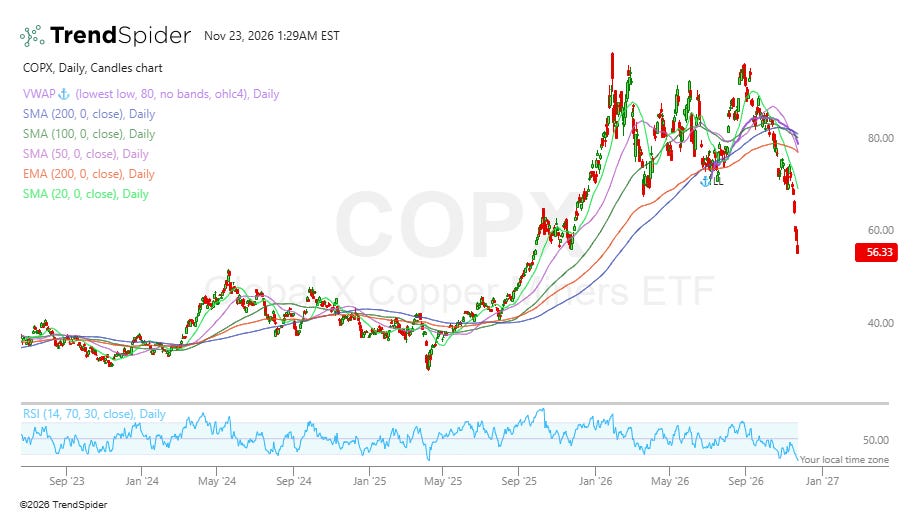
We remain bullish on copper, solar, scandium and precious metals... but this was a painful week.
Gold: −9.5% on the week, now ~21% below its 200-day. Last week I said gold was the most oversold since the December 2015 bottom. It’s now even more stretched.
Silver: −16.2% to ~$41 and now ~39% below its 200-day.
Put simply, silver is down ~41% this year, on track for its worst year in decades... worse than 2008 and worse than 2013. The gold-to-silver ratio has jumped back to ~86 and historically levels this high have been better moments to favour silver over gold.
Copper: −9.8%. No change to the long-term view. Supply is going backwards whilst AI and grid demand keeps rising. A lot of this week’s fall looks like the same forced selling we saw everywhere else…not a change in the copper market itself.
What’s Mispriced?
This is a section looking at the potential opportunities I’m seeing at the moment. I’ll split them by how I see the risk profile (high risk → low risk).
I aim for at least 3+ opportunities in every article I publish here but that depends on what the market is offering at the time of writing.
You’ll also likely see overlap week to week. I am not a trader that changes his mind every few hours, days, or even weeks. If I see an opportunity, that opportunity often stays around for weeks/months/years.
Last week we touched on:
Centrus Energy (LEU) - High Risk
Marvell (MRVL) - Medium Risk
Amazon (AMZN) - Low Risk
Denison Mines | DNN - High Risk
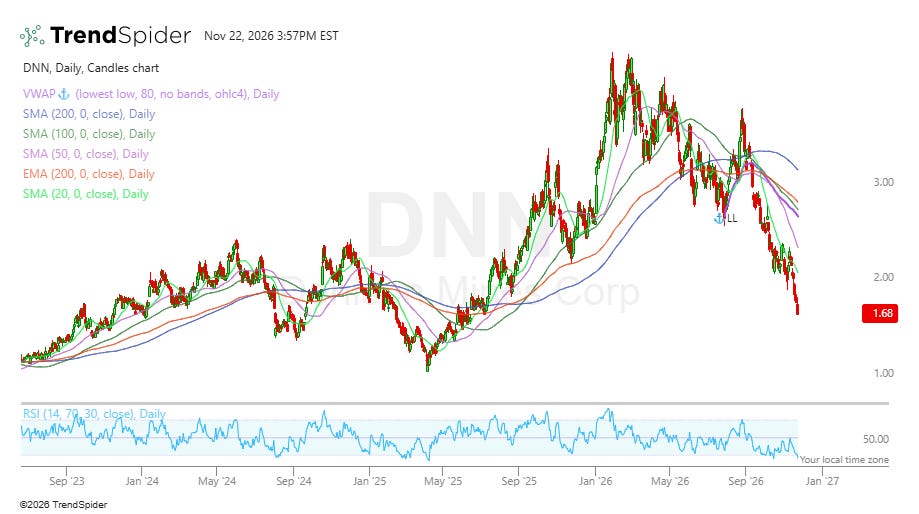
Uranium stocks have been sold alongside the rest of the AI-power trade whilst the commodity has gone the other way (especially relative to other commodities at the moment).
Long-term contract prices are at a record and have risen without a single pullback since January 2025.
The reason I’m bullish here is supply. Costs are rising at almost every producing mine (Kazakhstan’s are up ~40% in a year on sulphuric acid shortages), new projects keep slipping, and the largest mine in development isn’t expected to ramp up until the 2030s. The market needs new supply and that’s extremely bullish for the few who are actually producing it.
Denison (DNN) is building a lot of this supply. Phoenix, in Saskatchewan’s Athabasca Basin, will be Canada’s first ISR mine. It’s ~24% complete with first production targeted for H2 2028. Planned output is ~8.4Mlb/yr over the first five years (Denison owns 95%) which makes it one of the largest new mines globally this decade.
The feasibility study puts operating costs at ~$6/lb and all-in costs at ~$16/lb... against a current contract price in the high $90s.
Valuing these mining companies is extremely hard. It’s more of a bet on uranium itself but here’s my forecasts:
At $100/lb (in line with Citi’s 2028 estimates), Phoenix (DNN’s mine) at full production could make ~$670M a year before tax and royalties…or roughly ~$400M after them.
Against a ~$1.6B market cap, that looks cheap... ~4x earnings and ~2.5x EV/EBITDA in a full production year. For context, the largest listed producer (Kazatomprom) trades at ~6x EV/EBITDA.
But Phoenix is a 10-year mine with most of its production in the first five years, so peak-year multiples flatter it. The fairer way to value it is to add up all the cash it should make over its life and discount it back to today. At $100/lb that comes out at roughly $1.5-1.5B...only just above where Denison’s whole enterprise value sits today (~$1.65B).
In other words, the market is pricing Denison as if Phoenix is all it owns (at today’s uranium price). Everything else comes for free:
Gryphon, a second deposit on the same property planned at ~7.6Mlb/yr
A 22.5% stake in the McClean Lake mill and joint venture
A 25% stake in Midwest
Its exploration ground
It’s also sensitive to price. At $130/lb, Phoenix’s value rises to ~$2.2B as per my numbers. At $80/lb, it falls to ~$1.1B. With long-term contract prices already at a record ~$99, I think the skew is to the upside.
As I’ve said throughout this article, I’m not interested just yet in buying in to equities. I’m just curating a nice list of ones that will be good when I’m more interested.
